GuideSeptember 2026 · 6 min
Your first group run: what to expect
New to running clubs? Group run etiquette, pace groups and no-drop runs, what to bring for early humid starts in India, and what to do if you are slow.
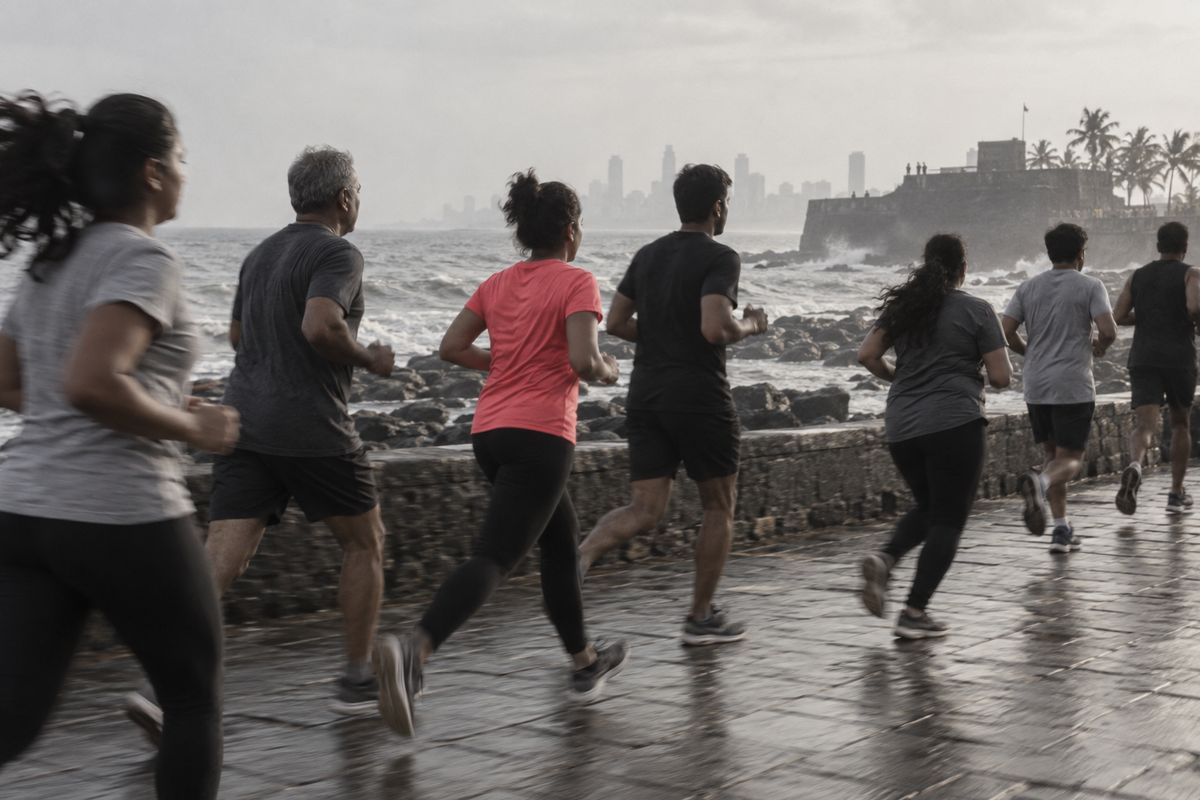
A first group run is mostly standing around, then running at a pace slower than you feared, then standing around again with tea. Most groups meet a few minutes before the start, set off together, stop to regroup at corners so nobody gets lost, and finish somewhere that sells chai or coffee. Nobody expects a newcomer to be fast. They expect you to turn up on time and not run off.
What happens at your first group run
You arrive at the meeting point, which is usually a gate, a landmark or the front of a café. There will be a small cluster of people stretching, talking, or looking at their phones. Somebody is the organiser, and it is worth finding them. Say it is your first time and roughly how far you normally run. That one sentence does most of the work, because they can then point you at the right group or the right person to stay with.
There is often a short briefing: the route, where the group will stop, and anything to watch for on the way. Then everyone sets off, usually a few minutes after the posted time, because somebody is always parking.
Larger clubs split into pace groups. Each group runs at a steady, agreed speed, sometimes with a lead runner at the front and another at the back making sure nobody is left behind. Smaller groups do not bother with this and simply run together, stopping at set points so the front waits for the back. That stop is the regroup, and it is the most important habit in group running. It is also why a slow newcomer is less of a problem than they think: the whole run is built around waiting.
Many groups call themselves no-drop, which means nobody is left alone on the route. If you see that phrase on a run, it is written for you. If you do not see it, ask.
Afterwards, most groups do not scatter. They walk to the nearest tea stall or café and sit for half an hour. For a lot of people this is the actual point of the morning, and it is where you stop being a stranger. Stay for it if you can.
Group run etiquette: the few rules that matter
Group running has very few rules, and all of them exist so that a dozen people can share a road without annoying each other or the people around them.
- Be on time. Groups wait for a minute or two, not ten. If you are going to be late, message the organiser rather than hoping they notice.
- Run two abreast at most. On a pavement or a narrow road, a wall of runners forces walkers, cyclists and cars around you. Drop into single file when it narrows.
- Call out hazards. A pothole, a loose dog, a car reversing, an uneven drain cover. Say it loudly and point, so the people behind you who cannot see the ground ahead know about it.
- Do not surge. Picking up the pace because you feel good pulls the group apart. Run at the group’s speed. If you want a faster day, join a faster group.
- Stop at the regroup. Even if you are ahead and feeling fine. Carrying on alone defeats the point.
- Say when you are leaving early. Otherwise somebody will go back looking for you.
Headphones are a matter of taste, but one ear free is polite in a group and sensible on any road with traffic.
What to bring to a group run in Indian heat and humidity
Most group runs in India start early, often between five and six in the morning, because by eight the heat has arrived. In coastal cities like Mumbai the humidity is there even before sunrise, and you will sweat more than you expect at a pace that would feel easy elsewhere. There is more on that in running in Mumbai.
The kit list is short:
- Water, even for a short run. Some groups set up a water stop and many do not. A small bottle or a handheld is enough, and in the humid months, some runners add an electrolyte tablet to their water.
- Shoes you have already run in, not a new pair bought for the occasion.
- Something light-coloured or reflective, because runs that start before sunrise spend some time on roads that are still dark.
- Your phone, a way home, and cash for chai afterwards.
Light, quick-drying clothes are better than cotton, which stays heavy once it is wet. Most people eat something small and easy before an early start; a banana is a common choice. During the monsoon, a cap keeps rain out of your eyes and a plastic pouch keeps the phone dry.
On hot days, the ordinary advice applies: drink more than usual, go easier than usual, and stop if you feel dizzy or sick. The NHS page on coping in hot weather is a plain summary of how to cope.
How to pick a beginner-friendly running club or group run
The easiest first run is one that tells you plainly what it is. Look for a stated distance you already know you can finish, a meeting point you can find, and a start time you will actually be awake for. Words like no-drop, social, easy or beginner in the title are good signs. A run described as a tempo session or intervals is not the one to start with.
A shorter run you finish comfortably is better than a long one you suffer through. You can move up next week, and if a race is where it is heading, there is a guide to choosing your first race. A group that meets every week at the same place and time is also easier to become a regular at than a one-off.
On Runstra, a run shows its time, where to meet, the distance if the host knows it, and who is going. The list of who is going matters: seeing a few names on it before you leave the house makes it much easier to go. Everyone going gets a reminder before it starts, so the time and place do not scroll away in a group chat. If you are looking for people rather than a specific run, there is more on that in how to find running partners.
What if you are too slow for the group?
This is the reason most people give for never going, and it is almost always misplaced. Beginner and social groups exist precisely because plenty of people run slowly. Somebody will be at the back, and in a group that regroups, being at the back just means you get less rest at the stops.
It helps to say it out loud at the start. Tell the organiser you are new and slow, and ask who usually runs at the back. There is nearly always someone happy to run with you. Walking parts of the route is normal, and in a beginner group, nobody should mind.
It also helps to remember that nobody is timing you. Runstra deliberately leaves tracking out: no pace, no distance log, no leaderboard. A group run on it is a place and a time with people attached, and what you record on your own watch, if anything, is your business.
Staying safe when you run with people you have not met
A group run is, among other things, a plan to meet strangers, so treat it like one. Meet somewhere public. Tell somebody where you are going and when you expect to be back. Keep your phone with you. If a run or a person feels wrong, leave; you owe nobody an explanation.
In practice, a public group run with a dozen people and a regular meeting point is one of the more sociable things you can do on a weekday morning. The first one is the only awkward one. By the third, you will be the person telling a newcomer where to stand.
If you want to see what runs are posted near you, Runstra is free; here is how to get it.