CitySeptember 2026 · 8 min
Running in Mumbai: where people run, and when
Where people actually run in Mumbai, from Marine Drive and Carter Road to Aarey and BKC, plus when to go, the monsoon, and how to find a running group.
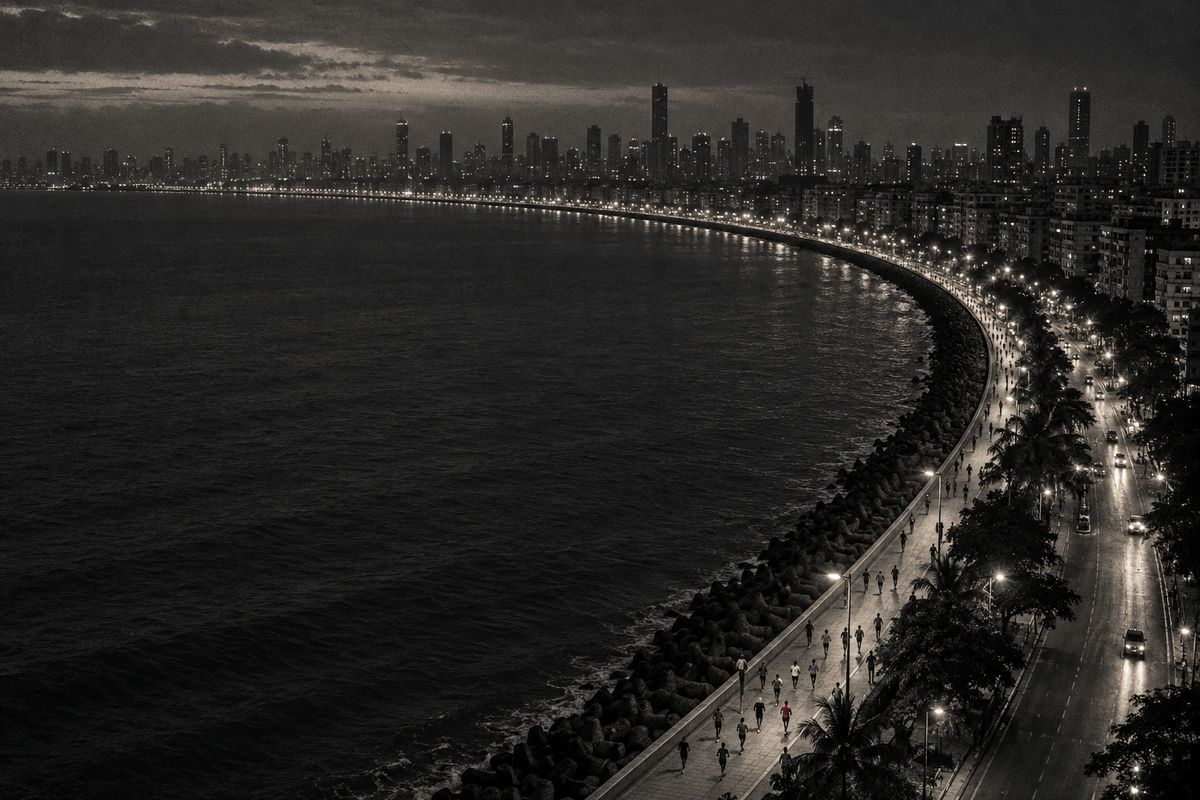
Most people who run in Mumbai run by the sea. Marine Drive, Worli Sea Face, Carter Road, Bandstand and Juhu are where you will see most runners in the morning, with Shivaji Park, Priyadarshini Park, Powai Lake, Aarey and BKC filling in the gaps. The trick is less where than when: go early, before the heat and the traffic, and go with other people if you can.
- Marine Drive, South Mumbai. Flat sea-front miles.
- Worli Sea Face and the Coastal Road promenade, Worli. Longer, quieter stretches by the water.
- Carter Road and Bandstand, Bandra. Short promenades, easy to link.
- Juhu Beach, Juhu. Running on sand at low tide.
- Shivaji Park, Dadar. Laps around a maidan.
- Priyadarshini Park, Malabar Hill. A proper track for intervals.
- Powai Lake, Powai. The eastern suburbs option.
- Aarey and Sanjay Gandhi National Park, the northern suburbs. Trees, shade and hills.
- BKC, Bandra Kurla Complex. Wide, empty roads on a Sunday.
Where to run in Mumbai
Marine Drive: the one everyone knows
The promenade runs about three and a half kilometres from Nariman Point to Girgaon Chowpatty. It is flat, wide, lit, and has the sea on one side the whole way, which is why it is the default answer to “where do people run in Mumbai”.
That is also the catch. It fills with walkers as the morning goes on, and once the sun is properly up you are weaving. There is almost no shade. Run it at first light, stay on the promenade rather than the road, and an out and back comes to roughly seven kilometres.
Worli Sea Face and the Coastal Road promenade
The old Worli Sea Face stretch runs a few kilometres along the water, with the Sea Link in view at the far end. It has always been a quieter alternative to Marine Drive for people living in Worli, Prabhadevi and Lower Parel.
The seafront around it has changed with the Coastal Road, which came with a long new promenade from the Priyadarshini Park end towards Worli, with footpaths and a cycle track. It has been opening in stages, so check what is open near you before you plan a long run on it.
Carter Road and Bandra Bandstand
Carter Road is the Bandra run. The promenade is a little over a kilometre along the water, with Joggers Park, a small park with a jogging track of its own, at its southern end.
From Joggers Park an ordinary stretch of road through Chuim Village takes you to Bandstand, the promenade that runs below the hill towards Bandra Fort. Link the two and you have a few kilometres one way, enough for a decent out and back. It is lovely at first light and much busier later, and weekend mornings are the busiest of all.
Juhu Beach: running on sand
Juhu is one of the few places in the city where you can run on the beach itself. At low tide the sand near the water is wide and packed hard, which makes it kinder on the legs than tarmac. At high tide there is far less of it, and the soft sand higher up is hard work.
Check the tide before you go, and do not take your best road shoes. Sand and salt get into everything.
Shivaji Park: laps in Dadar
Shivaji Park is a large open maidan with a path a little over a kilometre around its edge. On any given morning it is full of cricket nets, walkers, and people doing their laps. You are never far from where you started, which makes it a good place for a first long run.
Priyadarshini Park: a proper track by the sea
Priyadarshini Park, usually just PDP, sits on the sea at Nepean Sea Road below Malabar Hill. It has a 400 metre synthetic athletics track and a dirt path of about 500 metres under the coconut trees.
This is where you go when you want to do intervals and actually know the distance. The sea air is hard on the surface, so the track gets worn and relaid from time to time. If you arrive and it is under work, the dirt path is still there.
Powai Lake and the eastern suburbs
On the other side of the city, Powai has a short promenade along the lake. It is not long enough for a big run on its own, but it is flat, pleasant early on, and the roads around Hiranandani are where a lot of people in the area stretch it out.
Aarey and Sanjay Gandhi National Park: the green runs
North of the city the land turns green. The roads through Aarey Colony run through trees rather than buildings, with some gentle climbs that you will not find anywhere by the sea. Sanjay Gandhi National Park, near Borivali, has roads inside it that rise towards the Kanheri Caves.
Both are largely forest, not parks in the usual sense. Wildlife is real, some stretches are empty, and phone signal is not guaranteed. The national park also does not work on runner’s hours: early entry has generally been limited to walkers with a pass, and everyone else gets in later in the morning, well after the cool part of the day. Check the current rules on the national park’s own site before you plan around it. Go in a group and stick to the main roads.
BKC: wide roads on a Sunday
Bandra Kurla Complex is an office district, which is exactly why it works for running. On weekday mornings before the offices open, and especially on Sundays, the roads are wide, flat, quiet and well lit. It suits longer runs, because you can string together loops without stopping at a signal every few hundred metres.
Traffic returns fast once the working day starts.
When to run in Mumbai
Early. The best hour in Mumbai is the one before sunrise and the one just after it, when the air is as cool as it will get, the roads are empty and the promenades still have room. By mid-morning the heat and humidity make any hard effort miserable, and evenings rarely cool down enough to make up for it.
Sunday mornings are the best of the week. Traffic is lighter, and it is when most clubs and groups hold their longer runs.
Mumbai running through the seasons
- March to May is hot and very humid. Shorten your runs, slow down, and do not judge yourself by how you ran in January.
- June to September is the monsoon. It can pour for days, roads flood, and the sea wall at Marine Drive takes spray at high tide. Many people keep running through it; they just pick their days and routes more carefully, and keep an eye on the IMD forecast for Mumbai.
- October is hot again once the rain stops, with the humidity still hanging about.
- November to February is the good season. Mornings are cooler and drier, and it is when most of the city’s races are held, including the big marathon in January.
If you are picking something to train for, that winter window is the obvious one. We wrote about choosing your first race separately.
Practical things: water, shoes, traffic, dogs
- Water. Carry it, or know where you can buy it. In this humidity you lose more than you think, even on an easy five.
- Shoes in the monsoon. Wet paving, painted road markings and metal covers are slippery. Grip matters more than cushioning between June and September. Have a second pair so one can dry.
- Traffic. Stay on the promenade or footpath where there is one, run facing oncoming traffic where there is not, and do not assume a driver has seen you.
- Street dogs. Most ignore runners. Some do not, especially in the dark or around their own patch. Slow to a walk, do not stare them down, and give them room.
- Visibility. Before sunrise you are hard to see. Wear something light or reflective, and a small light does no harm.
Running alone early, and staying safe
The hours that are best for running are also the emptiest. On the busy promenades that is fine; on a quiet road in Aarey or an empty BKC road at half past five, it is worth thinking about. Tell someone where you are going and when you expect to be back. Stick to routes with other people on them. If you are meeting someone for the first time, meet somewhere public, like the start of a promenade or a park gate, and leave if it feels wrong.
Finding running groups in Mumbai
Mumbai has a lot of running groups. Almost every area with a promenade or a park has at least one, and plenty of them meet at the same corner every weekend. The difficulty is finding them, because most live in a WhatsApp group that you only hear about from someone already in it.
That is the gap Runstra is built for. The Runs tab shows runs posted near you, as a list or on a map, so you can see who is meeting at Carter Road on Saturday or at BKC on Sunday and say you are going. Clubs have their own pages, with their regular runs and a members list, and the Races tab lists the races worth training for in the city. Runstra does not track or record your run. It only gets you to the start with other people.
If turning up to a group of strangers sounds like a lot, our piece on your first group run covers what actually happens.
Runstra is free; here is how to get it.